
Interview as a Service in India: The Complete 2026 Buyer’s Guide
Interview as a service in India has gone from a curiosity to a line item in three years — driven by GCC expansion, funded hiring sprints, and the arithmetic that every interview hour is an engineering hour. What has not kept pace is buyer guidance. This guide is the version we would want if we were buying: the delivery models, how pricing actually works, the compliance questions your legal team will ask, an eight-point vendor scorecard, and a 30-day evaluation plan.
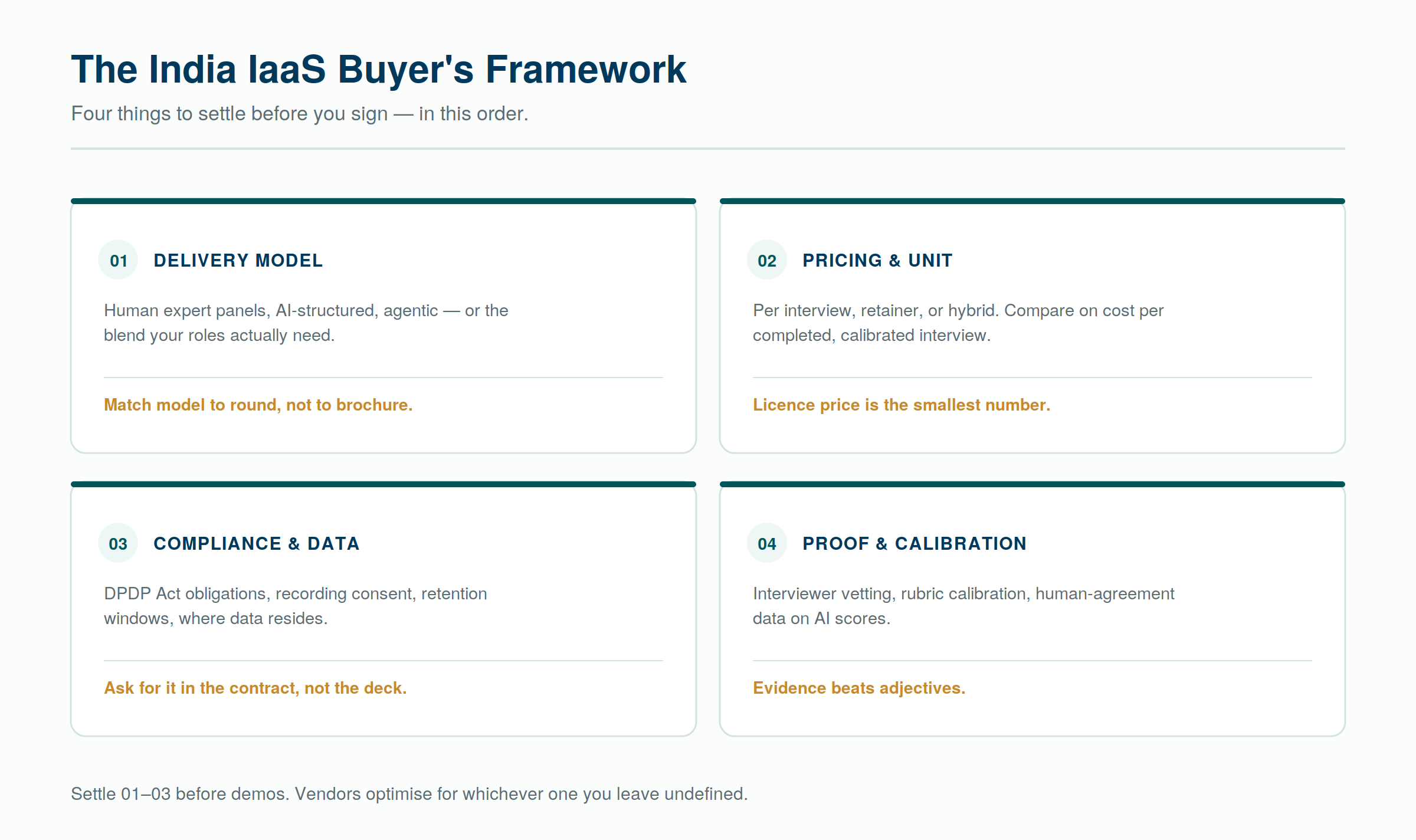
| Quick answer: Buying interview as a service in India comes down to four decisions: which delivery model fits each round (human expert panels, AI-structured, or agentic), which pricing structure fits your volume pattern (per interview, retainer, or hybrid), whether the provider’s DPDP Act and data-residency position survives contract review, and whether they can prove interviewer vetting and score calibration. Settle the first three before demos. |
What Interview as a Service Means in the Indian Market
Interview as a service is a model where an external provider conducts candidate interviews on an employer’s behalf and returns structured, recorded evaluations — the provider supplies capacity and consistency, the employer keeps every hiring decision. The full category explainer lives in our guide to what interview as a service is; this guide assumes you know the definition and are deciding whether and how to buy.
Three things make the Indian market distinct. Hiring here is bursty in a way that breaks fixed panels — campus seasons, funding-round sprints, and GCC ramp-ups create months where interview demand triples. Interviewer supply is genuinely deep, which is why a practitioner-panel model works here better than in smaller markets. And the compliance layer has hardened: the Digital Personal Data Protection Act now governs candidate data explicitly, which changes what belongs in a vendor contract.
The Three Delivery Models
Providers deliver capacity in three shapes. Human expert panels bring vetted practitioners to live rounds — the depth option for senior and specialist hiring. AI-structured interviews put every candidate through identical questions and rubrics, which is how consistency problems get solved structurally rather than through training. Agentic AI interviews conduct, probe, and score autonomously, giving always-on screening capacity.
The mature answer is not to choose one. Blend by round: AI or agentic for high-volume first rounds, expert human panels for senior and niche roles, in-house for finals where the job is judgement and selling the offer.
How Pricing Works
Three pricing structures dominate, and each optimises for a different volume pattern. The mistake buyers make is comparing headline rates across structures instead of modelling their own volume through each.
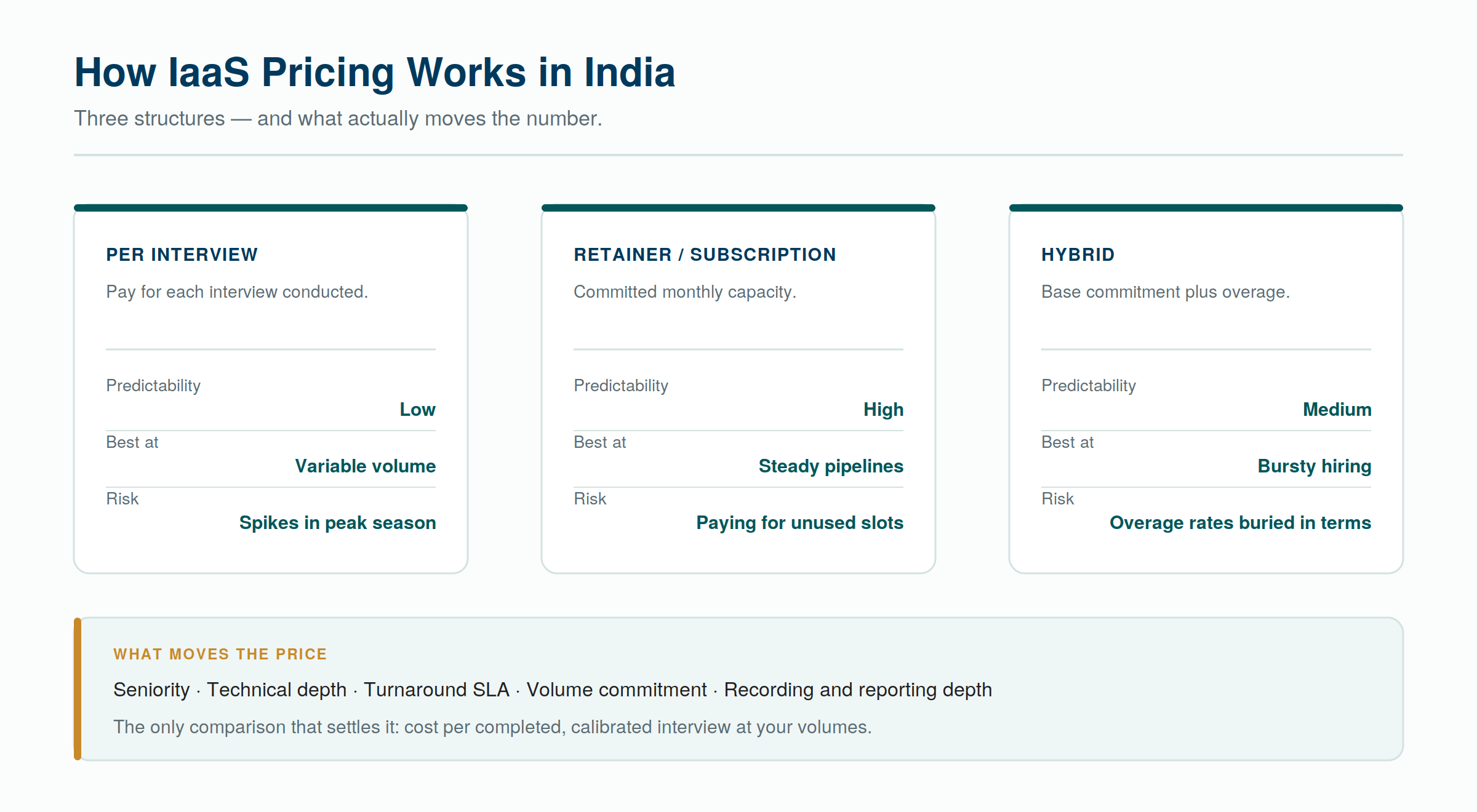
Model your last two quarters through all three structures, including your peak month rather than your average. Then set the comparison against the in-house baseline: interviewer hours × loaded cost of those people, plus the delivery work those hours displaced. That second number is what makes the business case, and it is the one most teams never calculate.
One caution on the arithmetic: a per-interview rate that looks high against a junior interviewer’s hourly cost usually looks cheap against a staff engineer’s — and it is staff engineers whose calendars actually break. Price against the people you are really spending.
The 8-Point Vendor Scorecard
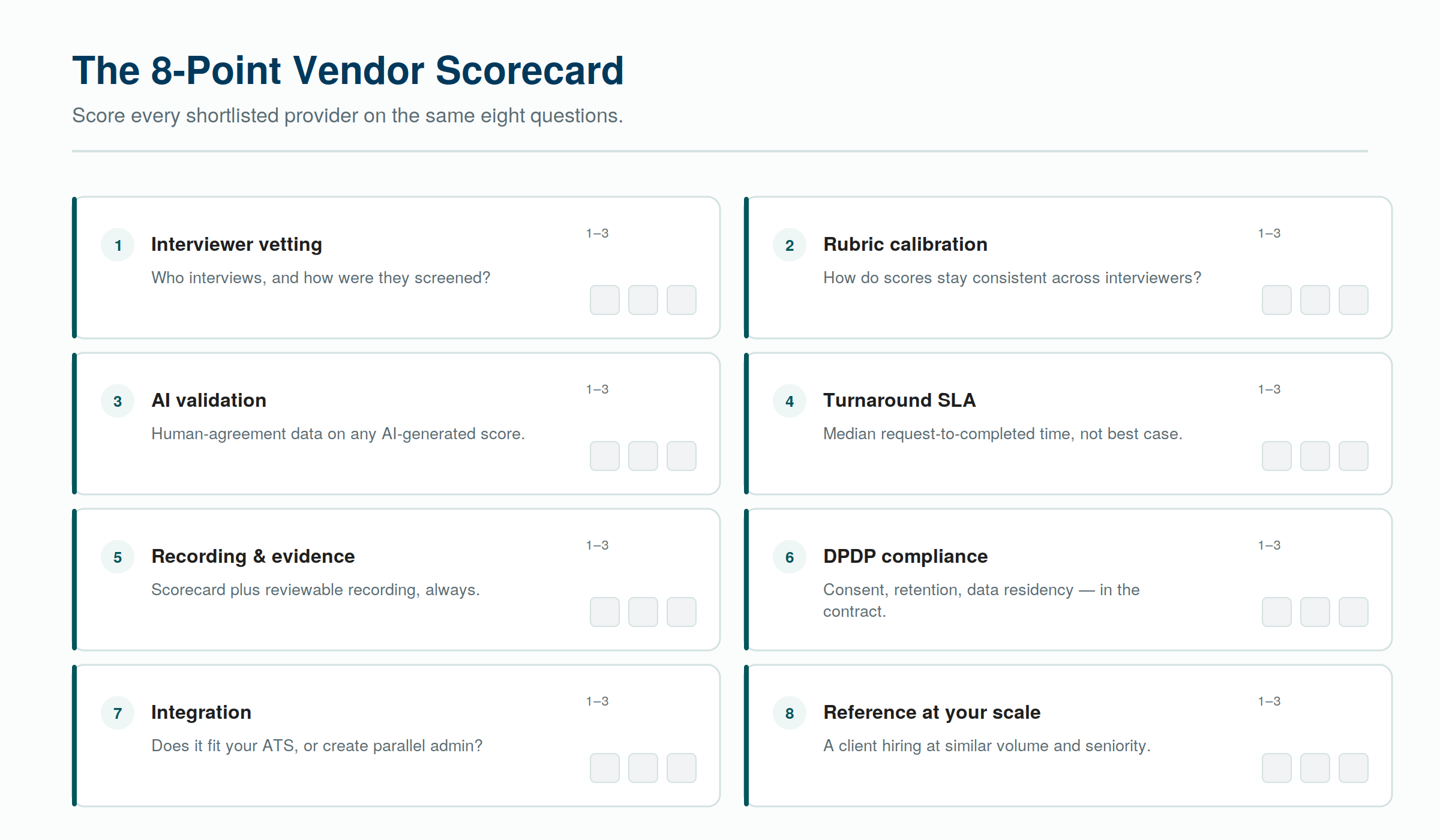
Score every shortlisted provider on the same eight questions, and make them answer on record. The pattern to watch for: strong vendors answer with artifacts, weak ones answer with adjectives.
1. Interviewer supply and vetting
India’s IaaS market runs on a panel of working practitioners, and panel quality is the product. Ask how interviewers are sourced, what screening they pass, and whether the same interviewers return for your roles — a rotating cast of strangers produces a rotating bar. Expert panel networks should be able to describe depth by stack and seniority, not just headcount.
Ask for: interviewer profiles for your specific stack, and the vetting steps each passed.
2. Calibration and score consistency
A panel without calibration is a lottery with better paperwork. Providers should run rubric training, shadow scoring, and periodic drift checks — and be able to show what happens when two interviewers disagree on the same candidate.
Ask for: their calibration process in writing, plus inter-rater agreement figures if they hold them.
3. AI validation, where AI is used
AI-structured interviews and agentic AI interviews have moved from novelty to normal in Indian hiring, and they solve the consistency problem structurally. But an AI score is a judgement, and unvalidated judgement at scale is risk at scale. This is the single question most buyers skip.
Ask for: human-agreement data on AI-generated scores, and documentation of bias testing.
4. Turnaround and coverage
Indian hiring runs across time zones — GCC teams supporting US and EU hours, startups hiring around the clock during funded sprints. Ask for the median request-to-completed interview time, coverage windows, and what happens when a candidate no-shows or reschedules at short notice.
Ask for: median turnaround from the last quarter, not the best case in the deck.
5. Evidence returned
You should receive a rubric-scored card and a reviewable recording for every interview — evidence you can audit, not a verdict you must trust. This matters twice over: for your own hiring quality, and for defensibility if a rejection is ever questioned.
Ask for: a redacted sample scorecard and recording from a real interview.
6. DPDP Act and data handling
India’s Digital Personal Data Protection Act, 2023 governs candidate personal data, and interview recordings are personal data. Consent language, retention windows, deletion on request, and where data physically resides all belong in the contract rather than the sales conversation. Enterprise and regulated buyers should expect these questions from their own legal review anyway — better to have answers before that meeting.
Ask for: their consent flow, retention policy, data-residency position, and sub-processor list.
7. Integration with your stack
A provider that cannot exchange data with your ATS creates a parallel admin process — and the coordination hours you saved on interviews reappear as status-chasing. Ask what integrates natively, what needs middleware, and what stays manual.
Ask for: a walkthrough of the actual data flow from request to scorecard in your ATS.
8. References at your scale
A reference hiring five people a quarter tells you nothing about your two-hundred-interview month. Insist on a reference operating at comparable volume and seniority — and ask them the questions the vendor cannot answer for them.
Ask for: a client reference hiring at your volume, in your role families.
The 30-Day Evaluation Plan
Evaluations without a clock drift for a quarter. Thirty days is enough for a defensible decision if each week produces an artifact.
| Week | Action | Output |
| Week 1 | Define role families, volumes (including peak), and the rounds you would outsource; shortlist three providers | Requirement brief + shortlist |
| Week 2 | Structured demos on your real job descriptions; score all three on the eight criteria | Completed scorecards |
| Week 3 | Paid pilot: 15–25 real interviews across two role families, with your own panel shadow-scoring a subset | Agreement data on real candidates |
| Week 4 | Reference calls at your scale; legal review of DPDP and data terms; cost model per completed interview | Decision memo |
The pilot is the part not to skip. Shadow-scoring even a handful of interviews tells you more about calibration than any deck — and if a provider resists a paid pilot, that is itself the finding.
Where IaaS Fits Alongside Campus Hiring
For companies hiring from campus, interview capacity is the binding constraint by definition: hundreds of first-round interviews compressed into a few weeks, against a fixed engineering team. IaaS is the standard answer to that shape, and it pairs with the platform decisions covered in our campus hiring platform guide. The two buying decisions are related but separate — one is about drive operations, the other about who conducts the interviews.
Buying interview as a service in India is not a difficult decision once it is framed correctly: match the model to the round, model your own volume through each pricing structure, get the data terms into the contract, and make vendors prove calibration with artifacts rather than adjectives. Run the pilot. Sign on evidence.
futuremug delivers all three models — expert interview panels, AI interviews, and agentic AI interviews — with the calibration, evidence, and data terms this guide tells you to demand. If your 30-day evaluation ends in a pilot, we would be glad to be one of the providers you stress-test.



Frequently Asked Questions
Interview as a service in India is a hiring model where an external provider conducts your candidate interviews — using vetted expert interviewers, AI interviewers, or both — and returns structured, recorded scorecards. The provider supplies interview capacity; you keep the hiring decision. For a plain-English introduction to the category, see our guide to what interview as a service is.
Pricing follows three structures — per interview conducted, a monthly retainer for committed capacity, or a hybrid of base plus overage. Published rates are rare because seniority, technical depth, turnaround SLA, and volume commitment all move the number. Compare providers on cost per completed, calibrated interview at your actual volumes, and benchmark that against your own panel hours at loaded cost.
Yes, and the compliance question is about data rather than legality. Interview recordings and candidate details are personal data under the Digital Personal Data Protection Act, 2023, so consent, retention limits, deletion rights, and data residency need to be settled in the contract. Any credible provider will have documented positions on all four.
Most Indian teams end up blending them rather than choosing. AI-structured and agentic interviews handle high-volume first rounds with perfect consistency; human expert panels carry senior, specialist, and judgement-heavy rounds; final rounds usually stay in-house because nobody outside your company sells the role as well. Match the model to the round.
A staffing agency sources candidates and charges a percentage of first-year CTC. An RPO takes over recruitment functions broadly. Interview as a service does neither — it does not source anyone and does not own your process; it supplies interview capacity and consistency, priced per interview. Teams short on pipeline need an agency; teams short on panel time need IaaS.
Onboarding typically runs one to three weeks: role calibration sessions, rubric agreement, ATS integration, and a pilot batch. Providers promising same-day starts are usually skipping calibration — which is exactly the step that makes outsourced interviews consistent